
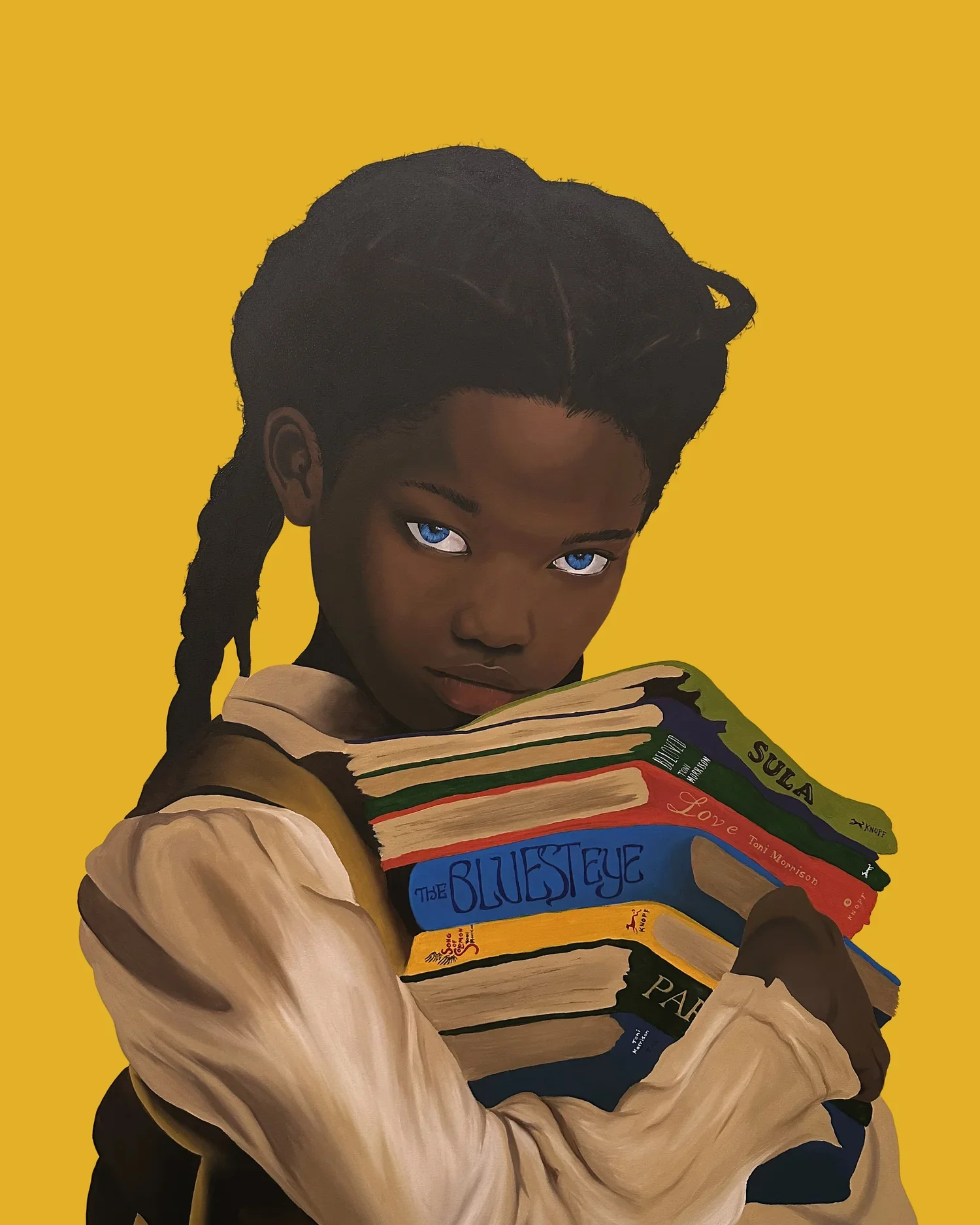
Blue Eyes
Oil & Acrylic on Canvas
Blue Eyes is a portrait by JENYES inspired by Toni Morrison’s novel The Bluest Eye and a childhood memory Morrison shared in a documentary. Morrison recalled being around twelve when a close friend told her she could prove God wasn’t real. Her friend had prayed for blue eyes every night for two years, and they never came.
That story stayed with me. I kept thinking about what it takes for a child to ask for the same thing night after night. Somewhere along the way, she had learned to believe that changing the color of her eyes could change something about her life. I wanted to make a painting that gave people a moment to sit with that feeling.
The Gaze
The title tells you where to look. The longer you stay with the eyes, the more you begin to notice the rest of the face and reconsider what you read in it at first. Morrison’s story adds another question to that encounter. What had that little girl been taught to see when she looked in the mirror? And who taught her that blue eyes would make the difference?
Limited Edition Print Release
Each artwork is available as a 16" x 20" Limited Edition Print, with only 10 prints produced per image. Printed on premium archival paper and individually numbered, these collector editions offer an opportunity to own a piece of the Cheers to the Culture exhibition in a more accessible format while preserving the exclusivity of the original works. Once all 10 prints have been sold, the edition will be permanently retired and never reproduced in this size again. Each print serves as a celebration of culture, achievement, and artistic storytelling, created for collectors who value both the artwork and the legacy it represents.
The Culture
When Toni Morrison published her first novel, The Bluest Eye, in 1970, she put a young Black girl named Pecola Breedlove at the center of an American story about beauty, race, and belonging. Pecola longs for blue eyes because she believes they might change the way people see her and, in turn, the way they treat her. In 1993, Morrison became the first Black woman to win the Nobel Prize in Literature. That recognition came more than two decades after a debut that asked readers to take seriously the inner life of a child whose pain the people around her had learned to overlook. loc.gov
1. Who gets to define beauty
In Morrison’s novel, blue eyes carry a promise. Pecola imagines that if she had them, she might finally receive the affection and tenderness she sees other people given. Through that wish, Morrison shows how a beauty standard can reach into a child’s life and shape what she believes she deserves. Bildspelsmanus_AN_EN.docx
2. Putting Black girlhood at the center
Morrison gave Pecola’s longing the full attention of a novel. As a Black woman writing about Black girlhood, she asked readers to spend time with the private thoughts of a child they might otherwise pass by. That choice still matters. Whose feelings get explored in detail, and whose are we expected to overlook? Say it Plain, Say it Loud
3. Bringing Morrison’s question into the portrait
When I heard Morrison tell the story of her childhood friend praying for blue eyes, I kept thinking about what that girl believed would happen if her prayer was answered. That’s what I wanted to sit with when I painted Blue Eyes. The title directs you to the eyes, but I want you to stay long enough to think about the person looking back. What had she been taught to see in herself? And what have we been taught to see in her?
Cheers
We honor life's most meaningful moments through art, transforming them into timeless treasures that transcend generations.
Celebrate
We celebrate life through art, presenting works that invite every viewer into a moment of admiration and salute.